

















In this post (10)
- What is physiotherapy branding?
- Who are you for? Decide your patients first
- How should a physio clinic choose a name and logo?
- What tone of voice suits a physiotherapy clinic?
- Why do real photos matter more than stock images?
- How do you keep your branding consistent?
- What proof builds trust in a physio brand?
- Which UK rules apply to how you describe your clinic?
- How can you test whether your branding works?
- Conclusion
Physiotherapy branding is how patients recognise, remember and trust your clinic, and it covers far more than a logo. Decide who you treat, keep your name, look, voice and photos the same everywhere, and back every claim with proof. Real Funnels helps UK private physiotherapy clinics win more patients.
Most clinic owners start with a logo. A logo helps, but patients judge a clinic by many small signs: how the website reads, what the Google profile shows, who is in the photos and what the reviews say. If those signs disagree with each other, trust drops.
This guide explains the parts of physiotherapy branding that matter, how to keep them consistent, and which UK rules apply when you describe what you treat.
We work with private physiotherapy clinics across the UK, so this is written for owners and practice managers, not designers.
Book your free strategy session. Is your area still open? We take one clinic per 50 miles.
What is physiotherapy branding?
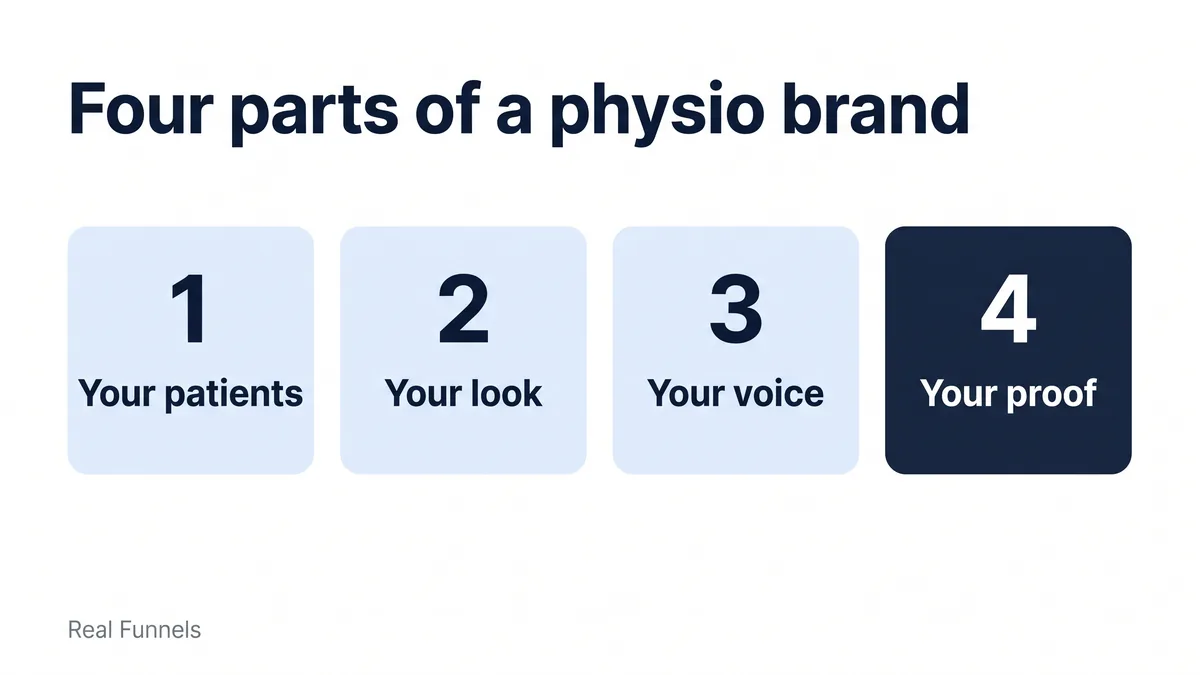
Physiotherapy branding is the set of choices that tell a patient who you are, who you help and why they can trust you. It includes your clinic name, logo, colours, photos, tone of voice and the proof you show, such as reviews and video stories.
A brand is not what you say about yourself. It is what a patient remembers after they have seen your website, read your reviews and spoken to your reception. Good branding makes those experiences match.
For a private clinic, that matters because patients compare clinics before they call. They are choosing someone to touch their body, so they look for signs that the clinic is professional, friendly and safe.
Who are you for? Decide your patients first
Start with the patient, not the colours. A clinic that tries to speak to everyone usually speaks to nobody. Pick the group you want more of and write them down.
Examples of clear groups are runners, desk workers with neck and back pain, people recovering from knee surgery, or older adults who want to stay active. You can treat other people too. The point is the message on the front of your brand.
Then write one sentence that finishes this line: we help [patients] to [outcome] with [how we do it]. Keep outcomes realistic. Do not promise results that depend on the patient.
Read what your best patients say in their reviews. They often use the exact words you need.

How should a physio clinic choose a name and logo?
Keep the name simple, easy to say on the phone and easy to spell. Check it is not too close to another clinic in your area, and check that the web address and social names are free.
For the logo, a simple mark that stays clear at a small size works best. Patients will see it first as a tiny circle on Google, on a phone screen and on a social profile. Test your logo at that size before you finalise it.
Choose two or three colours and one or two fonts, and write them in a short brand sheet. Calm, clean colours suit a clinic, but the main rule is to use the same ones everywhere.

What tone of voice suits a physiotherapy clinic?
Use plain English, short sentences and warm, direct words. Patients are often in pain or worried. They do not want jargon.
Compare these two lines.
| Jargon | Plain English |
|---|---|
| We provide musculoskeletal rehabilitation interventions | We help you get moving again after an injury |
| Initial subjective and objective evaluation | Your first appointment: we listen, check how you move and agree a plan |
Pick a few words that describe how you sound, such as friendly, clear and honest, and use them as a test for every page and every post.
Why do real photos matter more than stock images?
Patients want to see who will treat them. A team page with real photos and short, human bios builds trust faster than stock pictures of models. Show the clinic, the treatment room and the reception, so a new patient knows what to expect on day one.
Take photos with good light, and ask each person for permission before you publish. Keep the same style: similar colours, similar framing and a natural look.
Our guide on video testimonials for physiotherapy clinics explains how to capture patient stories properly, and our physiotherapy website design page shows how photos, price pages and booking fit together.
See how we build physiotherapy websites. Clear price pages, online booking and fast mobile pages.
How do you keep your branding consistent?
Consistency is where most clinics slip. The website looks one way, the Google profile another and the Instagram page a third. Use this checklist once a quarter.
- Name. The clinic name is spelled the same on the website, Google, social pages, emails and invoices.
- Logo and colours. The same files and colour codes are used everywhere.
- Address and phone. They match your Google Business Profile exactly. See our guide to Google Business Profile for physiotherapists.
- Photos. Recent photos of the real team and clinic on the website and profile.
- Wording. The same promise and tone on the homepage, service pages and ads.
- Social pages. The same profile picture, bio and link. Our guide to Instagram marketing for physiotherapy clinics covers what to post.
- Printed items. Uniforms, appointment cards and signs follow the brand sheet.
Write down who owns each item. A brand drifts when nobody is responsible for it.
What proof builds trust in a physio brand?
Proof is the part of branding patients trust most. The best forms are:
- Genuine Google reviews, which you can read more about in our guide to Google reviews for physiotherapy clinics.
- Short video stories from patients who agree to appear.
- Clear details about the clinicians, such as their training and registration.
- A real price page and a clear first appointment.
Never invent reviews and never ask patients to write in a certain way. Reply to every review in your own voice.
Which UK rules apply to how you describe your clinic?
Two sets of rules matter most for a physiotherapy brand: who can use the job title, and what you can claim about treatment.
Job titles. The Health and Care Professions Council (HCPC) says that physiotherapist and physical therapist are protected titles, and a person must be registered with the HCPC to use them. HCPC regulates individual professionals, not the organisations they work for. So make sure every person you describe on your website and profile is registered under the right title, and link to the HCPC register for each clinician if you can.
Treatment claims. The ASA and CAP give advice for physiotherapy advertising. They say physiotherapists are regulated by statute, and that claims to treat serious medical conditions are likely to be acceptable if you hold robust evidence. They say claims about aches and pains, back pain, joint pains, muscle spasms and minor sports injuries are likely to be accepted. Claims about other conditions need documentary evidence, most likely clinical trials.
Sources: HCPC, Professions and protected titles. ASA and CAP, Health: Physiotherapy (20 February 2024). This is advice from CAP, not legal advice.
So keep your brand promise broad and honest, and keep detailed claims on the page that holds the evidence. Avoid words such as best or number one unless you can prove them.

How can you test whether your branding works?
Ask five people who do not know your clinic to look at your website for ten seconds and tell you three things: who the clinic is for, what it does and what to do next. If they cannot, your message needs work.
Then check your numbers over time: calls, form enquiries and bookings from your website and your Google profile, and how patients say they found you. Branding takes time, so compare quarters rather than weeks, and change one thing at a time.
Our guide on physiotherapy marketing strategy shows how branding fits with ads, SEO and follow up, and our post on the best marketing agency for physiotherapists explains what to ask an agency.
Conclusion
Physiotherapy branding is a set of clear choices that you keep the same everywhere: who you help, how you look and sound and what proof you show. Start with your patients and your message, keep your name, photos and wording consistent and back every claim with evidence. Real Funnels helps UK private physiotherapy clinics win more patients with websites, ads and follow up, so your brand and your bookings work together. Book a free strategy session to see whether your area is still open.
Book your free strategy session. Real Funnels. Call +44 7530 505799.
Frequently asked questions
Physiotherapy branding is how patients recognise and trust your clinic. It covers your name, logo, colours, photos, tone of voice and the proof you show, such as reviews and video stories. A good brand makes your website, Google profile and social pages feel the same, so a new patient knows who you help and what to expect.
You need something simple that is clear at a small size, because patients will see it as a tiny image on Google and social media. But a logo is only one part. The message, photos, wording and reviews do more to build trust, so work on those at the same time.
No. The HCPC says physiotherapist and physical therapist are protected titles, and a person must be registered with the HCPC to use them. The HCPC regulates individual professionals, not the organisations they work for. Check that every clinician you describe on your website and profile is registered.
The ASA and CAP advice says claims about aches and pains, back pain, joint pains, muscle spasms and minor sports injuries are likely to be accepted. Claims about other conditions need documentary evidence, most likely clinical trials. This is advice from CAP, not legal advice, so check your own wording.
There is no set time. You can agree the basics, such as your patients, message, name, colours and tone, in a few weeks. A brand then grows as patients see the same signs on your website, your Google profile and your reviews. Check your numbers every quarter and change one thing at a time.