
Patient Referral Program for Physiotherapy Clinics That Works

In this guide
- A structured patient referral program converts existing goodwill into new bookings, but most clinics never ask systematically.
- The best moment to ask is at discharge, when satisfaction is at its highest point in the entire episode.
- Referred patients convert at a higher rate than almost any paid channel, because trust is already established.
- Asking once and never again produces a fraction of the result of a repeatable, automated system.
Satisfied patients refer people. That’s not a marketing theory, it’s just how word of mouth has always worked. The problem isn’t whether referrals happen. It’s that almost no physiotherapy clinic has an actual patient referral program, a repeatable process that asks systematically rather than hoping it happens on its own.
Left to chance, referrals still occur, just at a fraction of the rate they would with a structured ask. A patient who had a genuinely good experience and simply was never asked to refer anyone represents a booking a clinic left entirely on the table, at zero acquisition cost.
Why "hoping it happens" underperforms so badly
Most satisfied patients don’t think to refer unprompted. Not because they wouldn’t. Because recommending a healthcare provider isn’t something that occurs to most people in the normal flow of conversation, even when they’d happily do it if the thought crossed their mind at the right moment.
The moment of highest satisfaction passes without being used. Discharge, the point where a patient’s problem is resolved and gratitude is at its peak, is also the point where most clinics say goodbye and move on to the next patient, without ever asking.
There’s no easy way for a patient to actually refer someone even if they think of it. Without a clear next step, “you should try my physio” said in passing to a friend rarely converts into an actual booking, because the friend has to independently find the clinic, look it up, and decide to call.
When and how to actually ask
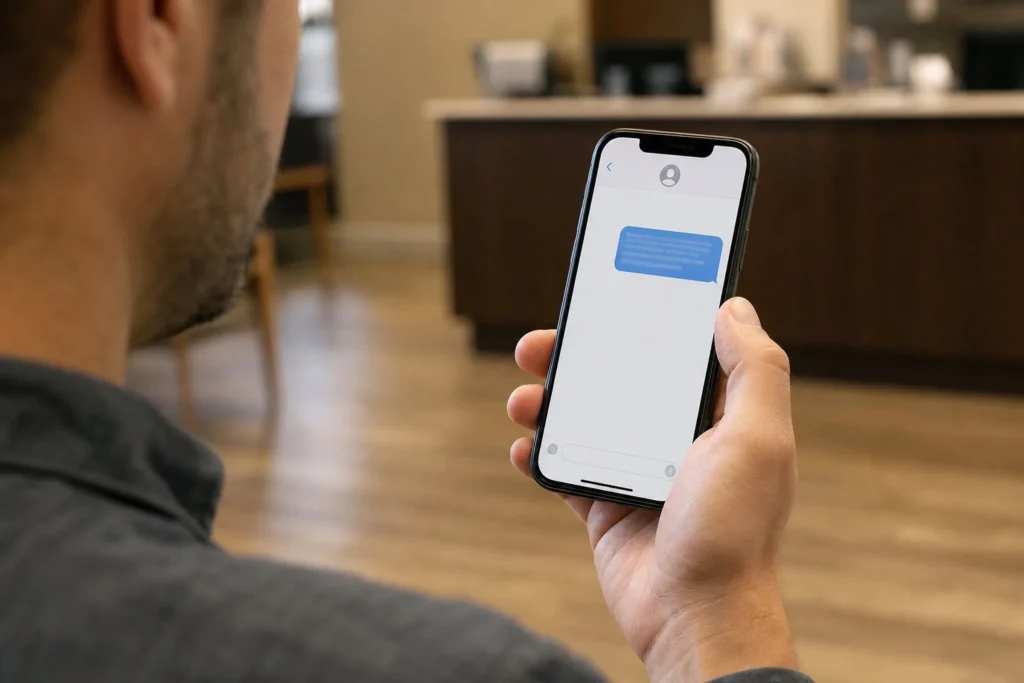
Ask at discharge, in person, while the relationship is warmest. A simple, genuine line, something close to “if you know anyone dealing with something similar, we’d love to help them too,” said directly by the treating clinician carries far more weight than any written message ever could.
Follow up with an automated message a few days later. Not everyone commits to something on the spot, and a short, low-pressure message shortly after discharge catches people who meant to refer but hadn’t got round to it yet.
Make the actual referral step frictionless. A simple link a patient can forward, or a clear instruction to just give a friend the clinic’s number, removes the barrier between good intention and an actual booked appointment.
Don’t lead with an incentive. A programme that opens with “refer a friend and get money off” frames the ask as transactional rather than genuine, and tends to attract price-motivated referrals rather than the well-matched patients that organic word of mouth produces. A modest thank-you after the fact, rather than an upfront bribe, preserves the authenticity that makes referrals convert so well in the first place.
Track who’s referring and acknowledge it. A brief, genuine thank you to a patient whose referral actually booked reinforces the behaviour and makes a second referral from the same person considerably more likely.
Building it as a repeatable system, not a one-off ask

Trigger the ask automatically at discharge, rather than relying on a busy clinician to remember every single time. Once discharge is logged in the system, the request and the follow-up message go out on their own.
Keep a simple record of referral source per new patient, so the clinic can actually see which past patients are generating new bookings, rather than referrals disappearing into “word of mouth” as an untracked, unmanaged category.
Connect it to the same communication system already handling reactivation and reviews. Our guide on automated patient reactivation and our guide on Google reviews for physiotherapy clinics both draw from the same patient goodwill that a referral programme relies on, and running all three from one system means a satisfied patient can be asked for a review and a referral without two separate disconnected processes.
This is one of the components we build into every GoHighLevel setup, triggered automatically off the same discharge event that starts reactivation sequencing.
Frequently asked questions
Ask in person at discharge with a genuine, simple line rather than a scripted pitch, and follow up with a short, low-pressure automated message a few days later for anyone who didn't refer on the spot.
Leading with an incentive tends to attract price-motivated referrals rather than well-matched patients. A modest thank-you after a referral books, rather than an upfront offer, generally preserves better referral quality.
At discharge, when satisfaction with the completed treatment is highest. This is the single most effective moment, far more effective than asking mid-treatment or leaving it entirely to chance.
Referred patients generally convert at a higher rate and require less persuasion, since the trust barrier a paid ad has to overcome has already been removed by the personal recommendation.
Yes. The ask itself works best delivered personally, but the trigger, timing, and follow-up message can all run automatically off the discharge event, removing dependence on a busy clinician remembering every time.
Keep reading
Real Funnels Ltd, 64 Nile Street, London N1 7SR · © 2026